
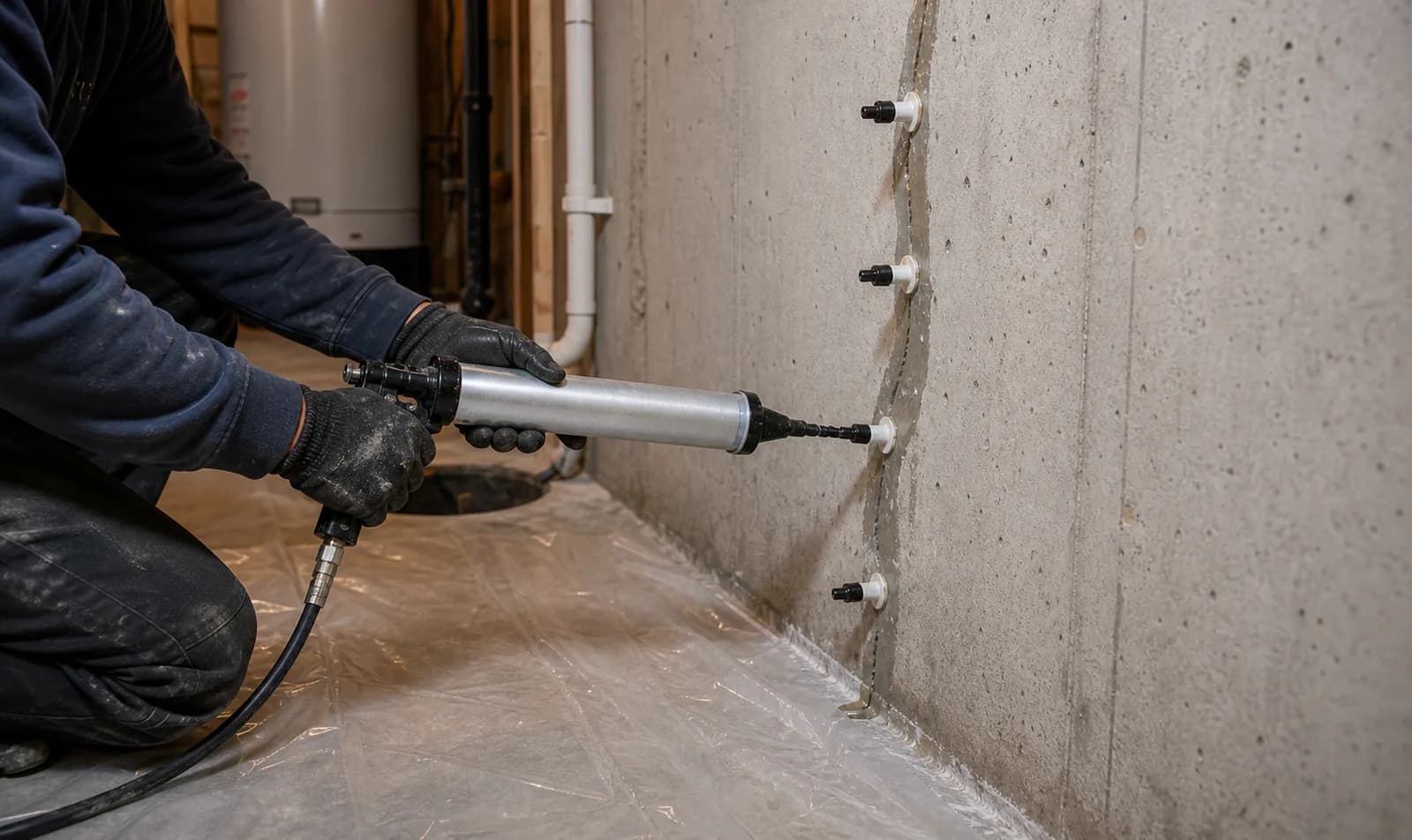
Foundation crack repair
A crack in a foundation wall lets water in, and it sometimes tells another story: soil movement, lateral pressure, a drain that no longer carries water away. ExcaFix starts by reading the crack — its type, its cause, how it is evolving — before choosing between epoxy injection, polyurethane injection or a repair from the outside. The method chosen and its scope are put in writing before the work.
Types of foundation cracks
Not all cracks are equal. Shape, orientation and behaviour over time say almost everything about the cause.
- Shrinkage crack — Thin, vertical or slightly inclined, often appearing within the first years after the pour. Concrete loses water as it cures and shrinks. It is the most common case and, generally, the least worrying: it no longer moves, but it can let water through.
- Vertical or diagonal crack — It often starts at the corner of a window, an opening or a change in wall height. A diagonal that is wider at the top than at the bottom can signal differential settlement: one part of the foundation has sunk more than the other.
- Horizontal crack — The most serious. It indicates lateral soil pressure — frost, saturated soil, poorly compacted backfill — pushing the wall inward. A bowing wall is a structural warning sign: it is not injected, it is assessed.
- Stair-step crack — Specific to concrete block or masonry foundations: it follows the mortar joints in a stair pattern. It reflects soil movement or settlement. Blocks cannot be injected the way poured concrete can; the repair is generally done from the outside.
- Active or dormant crack — A dormant crack has stopped moving; an active crack opens and closes with the seasons, or keeps widening. This is checked with reference marks placed on either side and read over time. The distinction dictates the product: a rigid material in a crack that moves will eventually fail.
A structural engineer is required before any repair when the crack is horizontal, when a wall bows or leans, when the two edges of the crack are offset, when the crack keeps widening, or when several cracks converge on the same area. In those cases injecting would only hide the problem; the solution — stabilization, underpinning, piles — is designed on plans. We tell you so at the outset rather than sell an injection that will not hold.
Diagnosis first: what we check before choosing
The method follows from the crack, not the other way around. Inside, we map each crack over its full length, measure its width, check whether it goes through the wall, whether it is damp, and whether traces of water or efflorescence surround it. When the basement is finished, a small opening in the drywall is often needed to see the concrete.
Outside, we look for the cause: downspouts discharging at the base of the wall, a lot that slopes towards the house, a driveway or deck directing water to the foundation, a mature tree whose roots dry out the clay — the National Research Council of Canada notes that in our clays it is this drying shrinkage that moves shallow foundations. We also note the foundation type: poured concrete, blocks, stone. The report is in writing, with photos, and it states what calls for injection, what calls for drainage, and what calls for an engineer.
Foundation crack repair: the methods
Two families of products cover most injection repairs on poured concrete. They do not do the same thing.
- Epoxy injection — structural repair — Epoxy is a rigid resin that penetrates the crack through the full thickness of the wall and bonds the two edges together. Once cured, it restores the wall's continuity. It suits dormant cracks, preferably dry at the time of injection, whose cause has been dealt with. It does not suit a crack that moves: the resin holds, and the concrete cracks again beside it.
- Polyurethane injection — waterproofing — Polyurethane reacts on contact with water and expands to fill the crack with a flexible, watertight foam. It accepts damp cracks, even with water actively coming in, and tolerates slight movement. It stops water; it does not strengthen the wall. It is the product for a crack that leaks, not for a crack that is working.
In both cases the injection is done under controlled pressure, through ports set along the crack, from the bottom up, until the product comes out at the next port: that is the proof that the crack is filled over its full depth. A surface seal applied on its own fills nothing; it hides the crack for a few months. The exact product, its data sheet and the installation method are named in the quote.
From the inside or from the outside?
Repair from the inside is the normal route for an accessible crack in poured concrete: no excavation, no damage to the lot, a few hours of work. It requires the concrete to be visible and the crack not to be hidden by a coating, thick paint or an old sealant. It does not apply to block or stone foundations, whose voids cannot be filled by injection.
Repair from the outside is the answer when the inside is inaccessible — a finished basement you do not want to open, a floor that hides the bottom of the crack — when the foundation is made of blocks, or when the crack is part of a larger problem: a detached membrane, a failed drain, a wall-to-footing joint letting water through. The area concerned is excavated down to the footing, the wall is cleaned, the crack is repaired, then a waterproofing membrane covering it generously is installed before backfilling. When the drain is at fault, it is dealt with in the same trench.
When the crack reveals a drainage problem
GCR points it out: the prescriptive part of the Construction Code designs foundation walls on the assumption of drained soil; saturated soil applies loads the walls were never designed to carry. A crack is therefore not always a crack problem. A clogged drain means pressure on the wall.
The clues that tilt towards drainage: efflorescence spread over several walls rather than concentrated on one crack; water where the floor meets the wall; leaks that come back in spring even after an injection; a sump pump that never stops; several cracks appearing on the same side of the house. In that case, injecting the crack fixes a consequence and leaves the cause in place. The diagnosis says so, and the quote then proposes the right sequence: drainage first, cracks afterwards or at the same time.
The steps of an injection
For a poured-concrete crack treated from the inside, the work always follows the same sequence.
- Preparation — The surface is cleared a few centimetres on either side of the crack: paint, coating, old sealant and dust are removed so the surface seal bonds to the concrete.
- Setting the injection ports — Ports are fixed on the crack at regular intervals, the first at the lowest accessible point, to cover the full length.
- Surface seal — An epoxy paste covers the crack between and around the ports. It holds the pressure during injection and keeps the product from escaping through the inside face.
- Injection — The chosen product — epoxy or polyurethane — is injected through the bottom port until it comes out at the next one, then port by port upward. That is how we know the crack is filled through the full thickness of the wall.
- Curing and finishing — After curing, the ports are removed and the surface is ground flush. Traces of the seal remain visible on a bare wall; they disappear behind a finish.
- Documentation — Before-and-after photos, product used, length treated: the file is handed over with the invoice and serves as the reference for the warranty.
Foundation crack repair cost: what moves the price
Interior injection of one crack generally runs from $400 to $1,500 per crack, several cracks or a staged repair from $800 to $2,500, and an exterior repair with excavation from $2,500 to $6,000. What moves the price:
- The number of cracks and their length: the second crack costs less than the first, since the trip is shared.
- The thickness of the wall and the depth of the crack, which determine the quantity of product.
- Access: a bare wall is injected directly; a finished basement means opening and closing the drywall.
- The condition of the crack: damp or actively leaking, it calls for polyurethane and sometimes a second pass.
- From the outside: the depth of the footing, obstacles (deck, porch, driveway) and the length of membrane to install.
- What the diagnosis adds: a drain to treat in the same trench changes the scale of the project.
Each item is detailed in the quote, with the product named. A crack "repaired" with surface sealant for a fraction of the price is not repaired.
After the work: documentation and written warranty
You receive the before-and-after photos, the name of the injected product and the length treated. When a warranty applies, its scope, duration, conditions and exclusions are set out in writing in the quote or the contract. An exterior repair includes, where applicable, the membrane manufacturer's warranty, which is separate from ours.
Then keep an eye on it. A repaired crack that reopens, or a new crack beside it, signals that the cause is still moving — and that is exactly the kind of thing worth showing us early.
Indicative pricing
| Interior crack injection | $400 – $1,500 per crack |
| Multiple cracks or staged repair | $800 – $2,500 |
| Exterior repair with excavation | $2,500 – $6,000 |
Indicative amounts only; the written quote determines the actual price. Indicative 2026 Quebec ranges; pricing and the follow-up timeframe are confirmed after your request is assessed.
Frequently asked questions
For an accessible crack in poured concrete, count on a few hours in general, curing included for fast-setting products. Several cracks, a finished basement to open or a very damp crack lengthen the job. The duration is confirmed after the assessment.
Understand the problem before digging.
Describe the visible signs and receive initial guidance. The on-site quote then confirms access, method and price.