
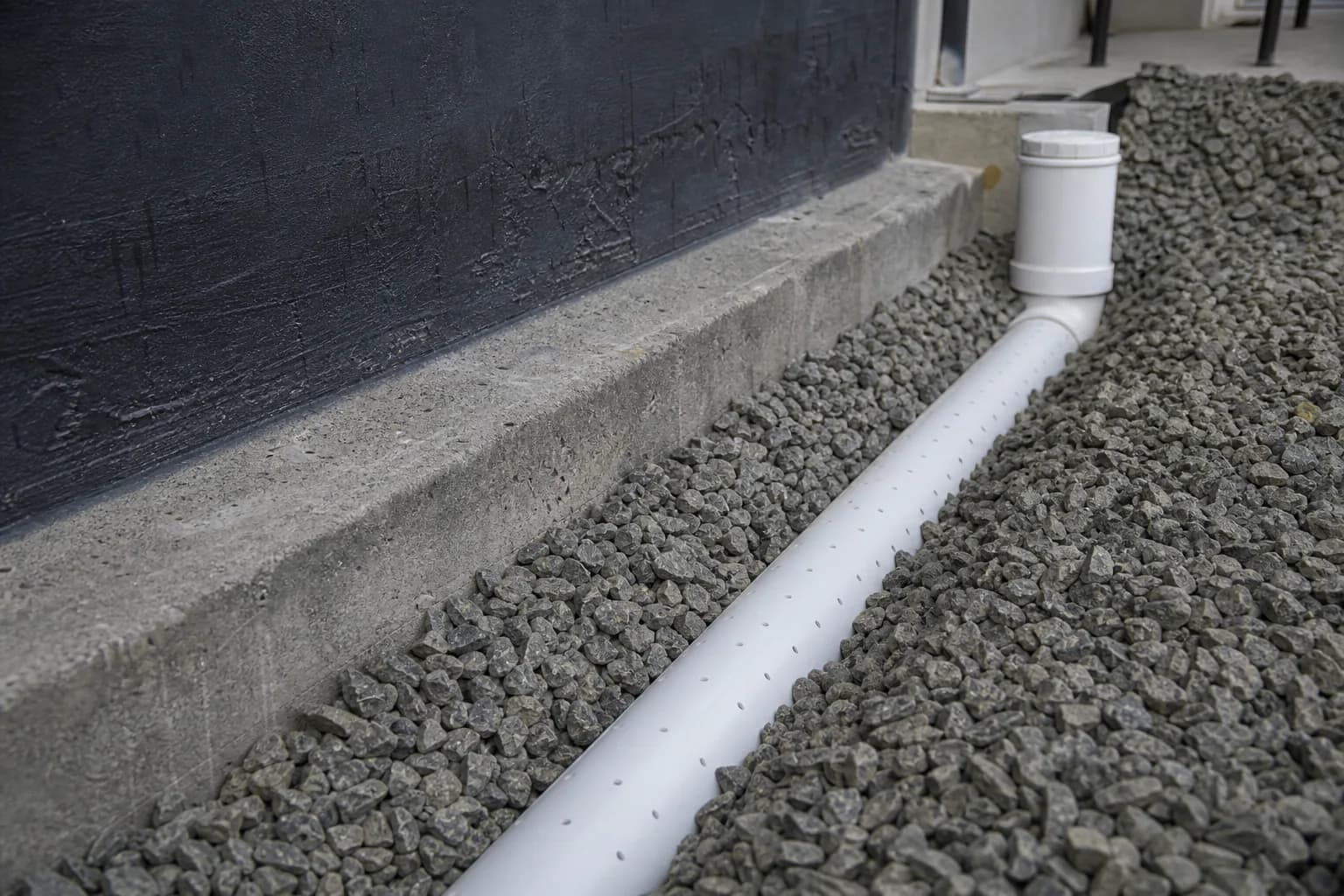
French drain: installation, replacement and repair
A French drain collects water at the base of the foundation and carries it away before it gets through the wall. When the drain is crushed, clogged or simply worn out, the basement shows it: efflorescence, dampness, a musty smell. ExcaFix starts with a diagnosis, then proposes the work that matches the actual condition of the drain, the soil and the foundation — a new installation, a full replacement or the repair of one section — with the scope in writing before the first shovel goes in.
Signs that the French drain is the problem
A foundation drain is invisible. What you see are the consequences of a drain that no longer carries water away. The most common signs in Quebec:
- Efflorescence: white, powdery traces on the basement concrete, left by the salts that water carries as it passes through the wall.
- Dampness or water where the wall meets the floor, especially in spring and after heavy rain.
- A persistent musty smell, mould at the base of the walls or behind furniture pushed against them.
- Paint that blisters or peels on the foundation walls.
- Backup at the floor drain, or a sump pump that never stops running.
- Water that pools along the foundation for hours after it rains.
Some signs point elsewhere, and sorting them out is exactly what a diagnosis is for, before anyone digs. A stain right under a window or at a downspout usually points to the gutters and the grade of the lot. Water that follows a single vertical crack is a crack repair, not a drain job. Condensation on the walls in summer comes from humid air, not from the ground. A backup that comes with thunderstorms and rises through the toilet or shower comes from the municipal sewer and is handled with a backwater valve. Replacing a French drain to fix a gutter problem costs a lot and fixes nothing.
Common causes in Quebec
A French drain rarely fails all at once. It wears down under conditions found everywhere in Greater Montreal and the Montérégie.
- Clay soils — The clay of the St. Lawrence valley is practically impermeable: water does not soak in, it travels along the wall and the drain has to carry all of it away. Contrary to a widespread belief, the National Research Council of Canada notes that these clays contain little or no swelling minerals; the dominant mechanism is shrinkage settlement when tree roots dry the soil out. A large mature tree near the wall is a factor worth noting.
- Freeze and thaw — Every winter the ground freezes and heaves, then releases in spring. A flexible drain without proper bedding ends up deformed, pinched or with a back-slope that holds water instead of draining it.
- The water table — When the water table sits high relative to the footings, water arrives continuously. Garantie de construction résidentielle (GCR) is clear: foundation drainage does not solve a shallow water table problem, and that situation calls for an engineer. We say so up front rather than sell a drain that will not be enough.
- Roots — Roots look for water. They enter through the perforations, clog the pipe and sometimes split it. Maples, poplars and willows planted close to the house are the classic cases.
- Original drains from the 1960s to 1980s — A large share of the region's housing dates from that period: in Montreal itself, 32.8% of dwellings were built between 1961 and 1980 according to the profiles published by the City. CAA-Québec puts the normal service life of a drain at about 40 years. Those original drains are past their useful life, and a neighbour's replacement is often a signal for the whole street.
- Iron ochre — In some soils rich in iron and poor in oxygen, bacteria turn the iron into a rust-coloured sludge that migrates to the drain and clogs it from the inside. The mechanism is described in note A-9.14.2.1 of the Quebec Construction Code, cited by GCR. Ochre cannot be stopped; it is managed with a smooth-wall drain fitted with access risers that allow inspection and cleaning.
Diagnosis first: moisture assessment and camera inspection
Digging blind is the most expensive way to learn what is wrong. Before proposing a method, we look at the whole house: the basement, its walls, the sump pit and pump, then the outside — the grade of the lot, downspouts, paved driveway, deck, trees. Damp areas and cracks are recorded and photographed.
Where there is an access point — a cleanout, an access riser, a sump or an interior connection — a camera is fed into the drain. The picture shows what the ground hides: a crushed or disconnected pipe, a back-slope holding water, roots, sediment, ochre deposits. It also locates the defect along the perimeter, which tells us whether a targeted repair is realistic. CAA-Québec recommends this camera inspection before deciding on a repair.
The camera has limits, and we will tell you what they are: it does not see the soil, the condition of the membrane on the wall, or a drain with no access point. In that case a test pit at a specific spot — a small exploratory excavation — says more than a guess. The result of the diagnosis is in writing: what we saw, what we recommend, and what we do not recommend.
Installation and replacement: the method step by step
A new installation and a full replacement follow the same path. The figures below come from the Quebec Construction Code (Chapter I – Building) and from the technical bulletins of GCR and the APCHQ: they are published requirements or recommendations, not our preferences.
- Locating underground utilities — The Safety Code for the construction industry requires checking for underground lines and locating their exact position before any excavation. Info-Excavation is the intended way to do it — a free service — and the RBQ states that the request is filed at least four business days before the work. Near a gas or water line, the buffer zone is cleared by hand, not with the excavator.
- Protecting the property — Tarps for the excavated soil, protection for trees, paving and flower beds, a clear corridor for the machinery. The Safety Code requires excavated material to be kept more than 1.2 m from the top of the trench walls and machinery more than 3 m away: that is why a drain project takes up as much of your lot as it does.
- Excavating down to the footing — The trench goes down to the base of the wall, to the top of the footing. Depending on depth and soil type, the walls are sloped or shored as the Safety Code requires. Bedrock, when present, is broken with a hydraulic hammer and changes the schedule.
- Removing the old drain and cleaning the wall — The old pipe, the clogged stone and the old membrane are removed. The foundation wall is cleaned and inspected over its full height: this is the only time anyone really sees the condition of the concrete.
- Crack repair and wall protection — Any cracks found are repaired before backfilling. Dampproofing — a coating or a membrane — is applied from finished grade down to the outside top of the footing, as article 9.13.2.4 of the Code requires: a membrane that stops halfway down the wall protects nothing.
- Laying the 100 mm perforated drain — Article 9.14.3.2 of the Code sets 100 mm (4 in.) as the minimum diameter of a foundation drain, and article 9.14.3.3 requires it to rest on undisturbed or well-compacted soil — never on loose fill, or it settles and develops a back-slope. GCR recommends a smooth-wall system conforming to standard BNQ 3661-500, with access risers for inspection and cleaning; that is what we propose when the soil allows it.
- At least 150 mm of clean stone — The sides and top of the drain are covered with at least 150 mm of clean crushed stone containing no more than 10% of particles passing a 4 mm sieve (Code, article 9.14.3.3). That limit is what separates genuine clean stone from dirty gravel that clogs the drain within a few years.
- Geotextile over the stone — When the soil is fine and likely to migrate into the stone, a geotextile fabric covers the stone bed — not the pipe itself, as the APCHQ points out. A "sock" wrapped around the drain clogs; a geotextile laid over the stone leaves a filtering volume.
- Connection and discharge — The collected water must be discharged to a sump pit with a pump, a sewer, a ditch or a dry well, according to what the municipal by-law allows. Towards the inside, GCR recommends a rigid, non-perforated pipe with a slope of at least 1% and a submerged elbow in the pit, which starves the ochre-forming bacteria of oxygen.
- Backfill and compaction — The backfill is chosen for the site, then compacted in layers to limit later settling along the house.
- Grading with a slope away from the house — The lot is graded so it slopes away from the foundation, then covered with topsoil. The photos taken before backfilling are handed over with the file: what is buried must remain verifiable.
Repair one section or replace everything?
CAA-Québec describes three options when a drain no longer carries water: cleaning when it is simply obstructed, partial reconstruction when a single run is at fault, and full replacement. The choice depends on what the diagnosis showed, not on the budget one would prefer to spend.
A partial repair makes sense when the defect is localized — a root, a pipe crushed under a driveway, a broken connection — and the rest of the drain looks sound on camera. Only the affected area is excavated, the section is replaced and reconnected to the existing drain. The lot is barely disturbed, and so is the bill. Bear in mind, though, that new is being joined to old: if the rest of the drain is the same age as the failed section, the next failure is not far off.
Full replacement is the answer when the original drain is at the end of its life, when ochre or sediment has invaded several sections, when the membrane is missing or detached, or when the camera finds nothing sound to connect to. Redoing everything while the trench is open avoids reopening the lot two years later.
Materials and references
The products are named in the quote, with their standard. Reference points you can check yourself:
- The common flexible corrugated drain must meet standard BNQ 3624-115; the marking is printed on the pipe.
- The smooth-wall system with access risers meets standard BNQ 3661-500, on 100 mm PVC pipe to BNQ 3624-130: it is GCR's stated "best practice", and the solution it recommends "at all times" in soils prone to ochre.
- Clean crushed stone, no more than 10% fines passing a 4 mm sieve: ask for the aggregate data sheet.
- Waterproofing membrane installed to the manufacturer's instructions, down to the top of the footing.
- Reference documents: Quebec Construction Code, Chapter I – Building, section 9.14; GCR technical bulletins FT-9.14.-01 and FT-9.14.-02; APCHQ bulletin S3-01 on foundation drainage.
Two honest caveats. The Code prescribes no minimum slope for the perimeter drain itself: a contractor who "guarantees" a regulatory slope is citing an article that does not exist. And a new drain solves neither a high water table nor a gutter problem: those causes are dealt with separately.
How long does a French drain project take?
Three to seven days for a full installation or replacement, one to two days for a targeted repair: those are reference points for a typical house with normal access. The actual schedule depends on the depth of the footing, the soil (bedrock and saturated clay slow everything down), the room available for machinery, the obstacles to dismantle — deck, porch, paved driveway — and the weather. A trench never stays open longer than necessary: it is backfilled as soon as the system has been checked and photographed.
Allow for the administrative lead time before the first shovel goes in as well: locating underground utilities, the municipal permit where one is required, ordering materials. A real drain project is planned a week ahead, not the day after the call.
French drain cost: what moves the price
In Quebec, a complete new installation generally runs from $10,000 to $25,000, a full replacement from $12,000 to $28,000 and a partial repair from $3,000 to $8,000. The ranges are wide because the projects are too. What moves the price:
- The perimeter to drain, in linear feet, and the depth of the footing.
- Access: an excavator that can move freely costs less than a partly manual dig between two closely spaced houses.
- The soil: bedrock calls for a hydraulic hammer and a surcharge of $3,000 to $10,000 depending on the extent; saturated clay slows the work.
- Obstacles to remove and put back: deck, porch, fence, paved driveway, flower beds.
- The condition of the wall: cracks to repair, membrane to redo, wall-to-footing joint to treat.
- Discharge: a sump pit to install or bring up to code, a connection to redo, a dry well to dig.
- Handling the excavated soil and restoring the site: soil to haul away, topsoil, sod.
The quote itemizes each of these. An unusually low price deserves a comparison of stone quantities, drain type, membrane and exclusions before signing.
After the work: documentation and written warranty
You receive the photos of the system before backfill, a description of what was installed and the location of the access risers where there are any. When a warranty applies to the work, its scope, duration, conditions and exclusions are set out in writing in the quote or the contract — never promised verbally.
The upkeep that remains is simple: keep the downspouts away from the foundation, keep the grade sloping away from the house, and clean the sump pit every year as CAA-Québec recommends, since drainage water deposits sand and soil that eventually interfere with the pump.
Indicative pricing
| Complete new installation | $10,000 – $25,000 |
| Complete drain replacement | $12,000 – $28,000 |
| Partial repair | $3,000 – $8,000 |
Indicative amounts only; the written quote determines the actual price. Indicative 2026 Quebec ranges; pricing and the follow-up timeframe are confirmed after your request is assessed.
Frequently asked questions
CAA-Québec puts the normal service life of a foundation drain at about 40 years. Actual life depends on the material, the soil, nearby roots, the quality of the installation and the upkeep of the sump pit. A house from the 1960s to 1980s that still has its original drain is in the end-of-life zone.
Understand the problem before digging.
Describe the visible signs and receive initial guidance. The on-site quote then confirms access, method and price.